
Tools and providers
How Find a Tender and CCS frameworks shape UK proposal software
Proposal software helps UK bidders store Find a Tender deadlines, CCS framework rates and reusable social value responses in one auditable place.
What to take away
- Proposal software earns its keep in UK public sector bids when it holds Find a Tender deadlines, framework rates and evidence together.
- Crown Commercial Service framework rates should live in the same tool as the bid, not in a spreadsheet that nobody owns.
- A social value response library cuts writing time on every regulated procurement, provided the entries are dated and tied to a policy outcome.
- G-Cloud 14 and Technology Services 3 suit different buying patterns, so your shortlist should follow the route the buyer is actually using.
- Certificates, insurance and policy documents expire quietly. The tool should chase them before a buyer does.
How Find a Tender deadlines change the way you build proposals
The Find a Tender Service is the UK's own notice board for above-threshold contracts, live since January 2021. It replaced the EU's TED for domestic procurements. For a bid team, it is the clock.
Back-planning a Find a Tender bid
- Submission deadlinefixed time of day
- Clarification cut-offbuyer question window
- Drafting and reviewowners and due dates
- Pricing sign-offcommercial lead
- Social value approvalaccountable owner
Every notice carries a submission deadline, and that deadline is fixed. Late means excluded, and no amount of good writing rescues it. So the tool you write in should know the deadline before you write anything.
Deadlines are a data field, not a diary note
Most teams paste deadlines into a shared calendar. That works until someone goes on leave. A better pattern is a notice record inside the proposal tool: buyer, reference, route, value band, deadline, clarifications close date.
Once the deadline is a field, you can filter. Show me everything closing in the next fourteen days. Show me everything where clarifications close tomorrow. That is a work queue, not a reminder.
Where the notice data comes from
Find a Tender publishes notices as structured open data, and that data can be exported or read through an API rather than copied by hand.
Pull the fields you need, then map them to your own notice record: buyer, reference, route, value band, submission deadline and clarification close date. Map once and every new notice lands in the same shape, ready to filter.
Work backwards from the submission time
Find a Tender deadlines are usually set to a time of day, not just a date. Build the plan backwards from that moment and let the tool hold the intermediate dates.
- Enter the notice, buyer and submission deadline as structured fields.
- Add clarification cut-off, buyer question window and any site visit dates.
- Back-plan drafting, review, pricing sign-off and social value approval.
- Assign an owner to each stage with a due date inside the tool.
- Lock the final version at least one working day before submission.
Step five matters more than it sounds. Portals fail, uploads stall and PDFs render oddly. A day of slack is cheap insurance.
Keep the audit trail with the bid
UK public buyers increasingly ask how a decision was reached, and internal reviewers ask the same. If the deadline, the version history and the approvals all sit in the same tool, answering either question takes minutes.
Teams that treat selection like a procurement project tend to get this right from the start, because they specify the audit requirement before they buy.
Where CCS framework rates belong inside a proposal tool
The Crown Commercial Service runs the UK's main commercial agreements for public bodies. If you sell software or services to government, your prices are probably governed by one of them.
Ceiling, floor and offered rate
Framework ceiling
- What it holds
- Maximum chargeable
- Who checks it
- Commercial lead
- Discount basis
- Volume, term
Committed floor
- What it holds
- Lowest honoured
- Who checks it
- Finance
- Discount basis
- Public sector status
Offered rate
- What it holds
- Price in this response
- Who checks it
- Bid manager
- Discount basis
- Stated on bid
Framework rates are not marketing copy. They are contractual. A rate card stored in a personal drive will eventually be quoted wrongly, and that is a commercial problem, not a formatting one.
Treat the rate card as a controlled document
Give each framework its own record: agreement number, lot, rate card version, effective date, expiry date and the person who owns it. Link the record to every bid that relies on it.
In most tools that record is a custom field set: agreement number as text, lot as a pick list, rate card version as text, effective and expiry as dates, and an owner as a person field. Add a lookup field back to every bid that relies on the rate card.
Some tools call this a record type, others a custom object. The label matters less than having the fields, because the fields are what let a writer pull the right rate instead of retyping it.
When a bid references a rate, the writer should be pulling from that record rather than retyping a number. Retyping is where discounts get lost and ceilings get breached.
Distinguish ceiling, floor and offered rate
Three numbers matter on most agreements. The published maximum, the minimum you have committed to, and the rate you are actually offering on this call-off. Keep all three visible on the bid.
| Field | What it holds | Who checks it |
|---|---|---|
| Framework ceiling | Maximum chargeable rate under the agreement | Commercial lead |
| Committed floor | Lowest rate you have agreed to honour | Finance |
| Offered rate | Price in this specific response | Bid manager |
| Discount basis | Volume, term or public sector status | Commercial lead |
| Approval record | Who signed off the pricing | Director |
A table like this takes ten minutes to build and prevents the most expensive class of bid error.
Separate framework pricing from bespoke pricing
Public sector bids and private sector bids should not share a price library. The rules differ, the disclosure differs and the approval route differs.
Tag each price record with its route: framework call-off, open competition or direct award. Then a writer cannot accidentally drop a private-sector discount into a public bid.
Public procurement policy sets the boundaries here, and it is worth reading before you design the fields: Public procurement policy - GOV.UK explains the rules that affect software purchases.
Storing social value responses so they can be reused
Social value is now a scored part of most major UK public procurements. The Procurement Act and the accompanying national policy statements pushed it further up the evaluation, and buyers expect specific, evidenced commitments rather than warm words. The Procurement Act 2023 commenced on 24 February 2025, so bids run after that date sit under the new regime.
Social value entry checklist
- Commitment written in plain English
- Measure defined and achievable
- Reporting method agreed with delivery
- Evidence source identified and stored
- Owner named and review date set
- Location or region stated
- Approved by accountable person
That means most suppliers are writing the same arguments repeatedly. A library turns that repetition into an advantage.
Build the library around outcomes, not questions
Question wording changes between buyers. Outcomes do not. Structure the library by theme: employment, skills, carbon, supply chain, community, digital inclusion.
Within each theme, hold a set of modular answers. Each module should state the commitment, the measure, the reporting method and the evidence you can supply.
Date and attribute every entry
Social value claims age badly. A commitment made in 2023 may be undeliverable in 2026. Every entry needs a review date and a named owner.
- Commitment written in plain English, no jargon
- Measure defined and achievable within the contract term
- Reporting method agreed with the delivery team
- Evidence source identified and stored
- Owner named and review date set
- Location or region stated where the buyer asked for it
- Approved by the person accountable for delivery
Regional detail earns marks. A commitment tied to Glasgow, Manchester or Newport reads better than one that says "across the UK".
Keep the ethics line visible
Buyers increasingly test whether suppliers understand data protection and modern slavery reporting. The ICO and the Data Protection Act 2018 sit behind most data questions, and the answers should be consistent across every bid.
There are broader rules and ethics points worth holding in the same library, so a writer never has to invent a position under time pressure.
Mapping G-Cloud and Technology Services routes to your shortlist
Two Crown Commercial Service agreements cover most digital buying, and they behave differently. Knowing which one a buyer is using tells you how to shape the response.
G-Cloud 13 vs Technology Services 3
G-Cloud 13
- Response shape
- Listing plus call-off
- Tool enforces
- Published rates
- Buyer compares
- Listings
Technology Services 3
- Response shape
- Method, team, cases
- Tool enforces
- Named staff, CVs
- Buyer compares
- Method and team
Open competition
- Response shape
- Full tender response
- Tool enforces
- Word counts, reviews
- Buyer compares
- Whole response
G-Cloud 14 is the current agreement for cloud hosting, software and support bought from a digital marketplace listing. G-Cloud 13 remains live as a legacy agreement for call-offs already running.
G-Cloud 14 favours short, standardised service descriptions and published pricing. If a buyer is running a G-Cloud competition, they are comparing listings, so your listing content is your bid. The legacy terms sit with the G-Cloud 13 - GCA page.
Technology Services 3 covers larger digital outcomes: transformation, service design, integration and managed services. Bids here are longer, more narrative, and usually scored on method and team. The framework reference is Technology Services 3 - GCA.
Match the tool configuration to the route
A shortlist in your proposal tool should carry the route as a field. Then templates, word counts and review steps can differ automatically.
Typical response shape
- G-Cloud 14
- Listing plus short call-off response
- Technology Services 3
- Method, team, case studies
- Open competition
- Full tender response
What the tool should enforce
- G-Cloud 14
- Published rates, service definition version
- Technology Services 3
- Named staff, CV currency, phase pricing
- Open competition
- Compliance checklist, social value modules
This is also where your own buying decision matters. If you are choosing a tool, the best providers explained comparison is easier once you know which routes you bid on most.
Read the policy direction, not just the framework
UK procurement policy has moved towards treating public spending as a lever for domestic capability and resilience, and buyers now reward that in method statements, particularly around supply chain and security.
Procurement in the national interest - GOV.UK sets out that direction. Suppliers who reflect it in their method statements tend to score better than those who ignore it.
Keeping framework evidence and certificates current
Framework bids fail on paperwork more often than on prose. An expired certificate is a pass to the reject pile, and it is entirely avoidable.
Framework evidence register
- Cyber Essentials certificate
- Professional indemnity insurance
- Employers liability insurance
- ISO certifications buyers request
- Anti-bribery and environmental policies
- Modern slavery statement
- Expiry date and renewal owner per row
Evidence has three properties worth tracking: what it proves, when it expires, and who renews it. Store all three against the document.
The evidence register
Keep one register covering the documents buyers ask for repeatedly. Cyber Essentials, professional indemnity insurance, employers liability and the ISO certifications your buyers request should all sit in it. Add anti-bribery and environmental policies, plus your modern slavery statement.
Each row needs an expiry date and a renewal owner. Anything expiring within sixty days should appear on a dashboard, not in an inbox.
Version control beats folder naming
"Insurance 2026 final v3" is not version control. A proposal tool should hold the current version, the previous version, the approval and the expiry in one record.
When a buyer asks for evidence of insurance, you should be able to attach the current file in seconds and know it is the right one.
Renewals are a bid activity
Treat renewal dates as bid milestones. If a certificate expires mid-evaluation, you may be asked to confirm cover and fail to do so in time.
This is the sort of thing that tool implementation that sticks tends to catch early, because the register is populated during setup rather than after the first loss.
A worked example of a framework bid run from one tool
A mid-sized Leeds software supplier spots a Find a Tender notice for a local authority case management system. The route is a G-Cloud 13 call-off under the legacy agreement. Here is how the bid runs inside one tool.
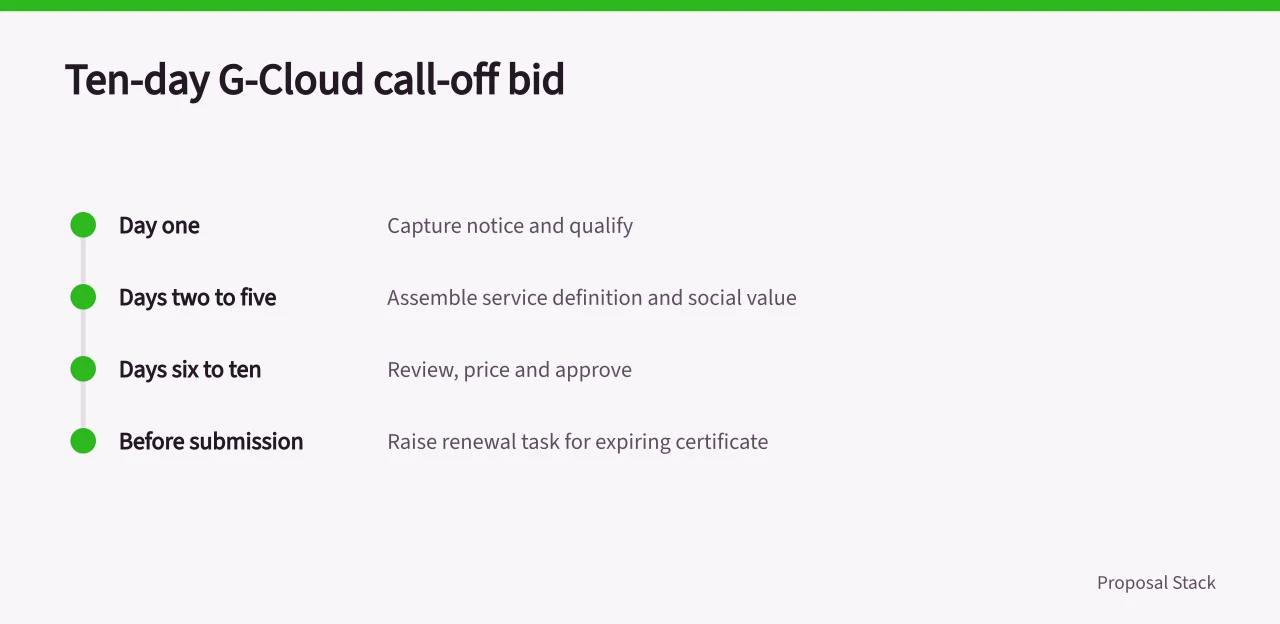
Day one: capture and qualify
The bid manager creates the notice record: buyer, reference, route, submission deadline, clarification cut-off. The tool flags that a mandatory site visit falls inside the clarification window.
A qualification check runs against the rate card. The published ceiling is compatible with the offered rate, so the bid proceeds. Had it not been, the tool would have blocked pricing sign-off.
Days two to five: assemble
The writer pulls the service definition from the G-Cloud listing record, so the description matches what the buyer can already see. Social value modules are selected by theme: two on digital inclusion, one on local employment in West Yorkshire.
Each module arrives with its measure, reporting method and owner already attached. The writer edits for fit rather than starting from a blank page.
Days six to ten: review and price
Pricing is generated from the framework rate record, with the discount basis stated. The commercial lead approves in the tool, which timestamps the decision.
The evidence register is checked automatically. One insurance certificate expires in nine weeks, so a renewal task is raised before submission rather than after.
Days eleven to thirteen: submit and learn
The final version is locked two working days before the deadline. The submission is logged with the portal reference.
When the outcome arrives, the debrief notes are attached to the same record. Next time a similar notice appears, the reusable modules, rates and evidence are already in place.
What the example shows
Nothing in that sequence is exotic. The gain comes from deadlines, rates, social value text and evidence each carrying an owner and a date.
That is the practical case for proposal software in UK public sector bidding. Not clever writing, but fewer avoidable failures.