

Rules and ethics
Part of Seven rules and ethics points for proposal software compliance
Check proposal software advertising rules before your next campaign
A UK checklist for proposal software campaigns: check PECR email rules, CAP Code claims, B2B advertising law, consent records and accurate AI claims.
What to take away
- For UK proposal software campaigns, check PECR before sending email and the CAP Code and B2B advertising rules before publishing claims.
- Record a UK GDPR lawful basis where you process personal data; it does not replace PECR's email rules.
- AI claims need evidence. BSI standards inform technical risk work, but they are not advertising rules.
- UK GDPR and the Data Protection Act 2018 apply to personal data in a quoting workflow.
This checklist is for UK campaigns. PECR, UK GDPR and the Data Protection Act 2018 apply across the UK, and the CAP Code is the UK non-broadcast advertising code. Check sector-specific or local requirements before extending a campaign. The wider proposal software rules and compliance guide covers contract terms and procurement questions.
Before you write the campaign
Pick a lawful basis
Where a campaign processes personal data, the UK GDPR requires a lawful basis. The ICO's Direct marketing guidance explains how to choose one; its six bases are consent, contract, legitimate interests, legal obligation, vital interests and public task.
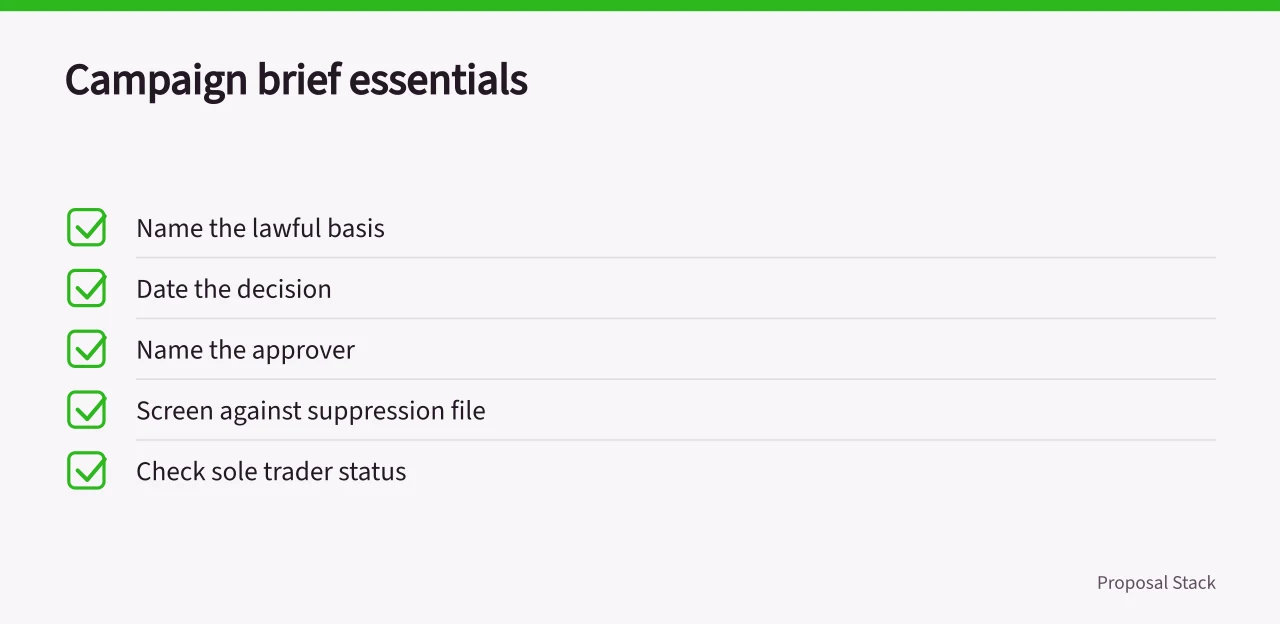
Legitimate interests may be a lawful basis for some B2B processing, but you need a balancing assessment. It does not remove PECR's separate electronic-mail rules, which depend on whether the recipient is an individual or corporate subscriber. Record the basis, date and approver in the campaign brief.
Pick a lawful basis
Which basis fits this campaign?
Legitimate interests: balancing assessment
Consent or contract: check ICO guidance
Check audience and suppression lists
Under PECR, unsolicited marketing email to an individual subscriber generally requires consent unless the soft opt-in applies; corporate subscribers do not need prior consent under that rule. Sole traders and some partnerships are individual subscribers. For all marketing emails, identify the sender and provide a valid address for opting out.
The PECR soft opt-in is limited: you must have obtained the details directly during a sale or negotiations for a sale, be marketing your own similar products or services, and have offered a clear chance to refuse at collection and in each message. A broker's cold list does not meet those conditions. A trial user qualifies only if the circumstances meet each condition.
Reviewing campaign copy
Evidence performance claims
For UK non-broadcast ads, use the CAP Code, the UK Code of Non-broadcast Advertising and Direct & Promotional Marketing; the ASA administers it. Section 3 covers misleading advertising, including rule 3.7 on substantiation and rules against misleading claims and material omissions. It also sets requirements for comparative claims, price and “free” claims, testimonials and endorsements; comparisons must be objective, relevant and verifiable, and compare products meeting the same need. A headline claiming a quoting tool halves proposal turnaround needs data behind it. Unsubstantiated claims can be challenged; keep the source, sample size and date.
For B2B advertising, also check the Business Protection from Misleading Marketing Regulations 2008. Trading Standards enforces these rules.
A vendor paying £600 a month for paid search should show where a three-times-faster claim came from. If that came from one internal trial, say so.
Describe AI features accurately
Buyers ask how a drafting suggestion was built. BSI publishes technical AI standards such as BS ISO/IEC 22989:2022 on terminology and BS ISO/IEC 23894:2023 on risk management. These can inform technical or security evidence, but they are not advertising rules and do not substantiate performance claims. Avoid words like autonomous unless the tool acts without review.
If your software sends customer data to a third-party model, that transfer belongs in your privacy notice. Our guide to a proposal software disclosure policy in England explains what that notice should contain.
Data handling in the quoting workflow
Map personal data
A quoting workflow touches names, email addresses, job titles and pricing history. The UK GDPR and Data Protection Act 2018 govern how that data is handled. The UK GDPR provides rights such as subject access and sets personal-data breach notification duties; the Act supplements it in UK law.
List every system that holds prospect data: CRM, email platform, e-signature tool, analytics. Note who can export from each. That list starts your data protection impact assessment.
Set retention dates
For a B2B sales cycle of six to nine months, a 24-month retention period can be an operational review point for lapsed prospect details, not a legal requirement. Set a review date for consent evidence too; at 24 months, document why any record remains necessary and delete it when it is not. Keep only the minimum suppression record needed to prevent further marketing.
Train quote builders to spot a data request. A prospect asking to see everything you hold is a subject access request, and the clock starts at once.
Glossary
- Lawful basisthe UK GDPR condition for processing personal data.
- PECRthe Privacy and Electronic Communications Regulations 2003, including rules for electronic-mail marketing.
- Soft opt-ina limited PECR exception for marketing to people whose details were obtained during a sale or negotiations for a sale.
- CAP Codethe UK Code of Non-broadcast Advertising and Direct & Promotional Marketing, administered by the ASA.
- SARsubject access request, a person's right to see your data.
- DPIAdata protection impact assessment, a written risk review.
Common questions
Does cold email to business addresses need consent in England?
Not always. Legitimate interests can cover business-to-business marketing where you have done a balancing assessment. Sole traders are treated as individuals and usually need consent. Record your reasoning.
Can I advertise AI drafting features without naming the model provider?
You can describe the function without naming the vendor, but do not overstate what the tool does. If data leaves your platform, disclose that in the privacy notice.
Who enforces advertising rules for software vendors?
The ASA administers the CAP Code and handles complaints. Trading Standards enforces the Business Protection from Misleading Marketing Regulations 2008 for misleading B2B advertising. The ICO regulates direct marketing under PECR and data protection law.
How long should I keep campaign consent records?
Keep evidence while relying on consent and use a documented 24-month review point; it is not a statutory retention limit. After review, retain records only while needed to demonstrate consent, and keep the minimum suppression record needed to honour an opt-out. Individual cases may need advice from a data protection adviser.