
Rules and ethics
Scotland vs England procurement, what changes for your quote templates
Quoting software for Scottish and English public bodies needs different templates, terms and framework routes. Here is what to change for both.
What to take away
- Quoting software templates built for England often fail north of the border because Scottish public body procedures, terminology and framework routes differ.
- Scottish procurement leans on the Single Procurement Document, the SPD, and PCS Scotland rather than Find a Tender and the standard selection questionnaire.
- England procurement is shaped by the Procurement Act 2023 and its central digital platform; Scotland runs its own legislation and its own portal.
- Framework access splits three waysCrown Commercial Service agreements, Scottish Government frameworks, and sector-specific routes like G-Cloud.
- One core quote template with switchable national wrappers covers both markets if you keep the commercial core fixed.
How Scottish public body procedures differ from England
Scotland buys differently because procurement is devolved. Health, education, local government and most public spending sit with the Scottish Government, so the rules that govern a bid in Glasgow are not the rules that govern a bid in Manchester.
That is the first thing to fix in your quoting software. If your template assumes one UK-wide process, your sales team will reuse the wrong language and the wrong documents on Scottish opportunities.
The portals are separate
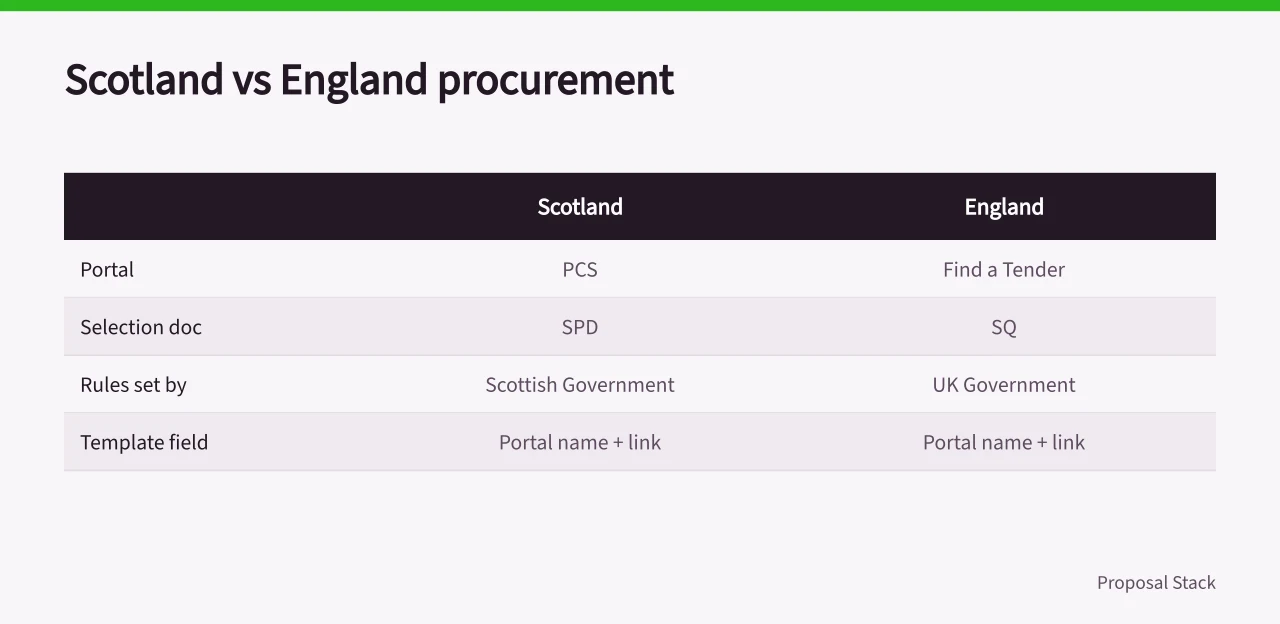
Scottish public bodies advertise contracts on Public Contracts Scotland, usually shortened to PCS. England, Wales and Northern Ireland use Find a Tender. Some Scottish bodies also post on Find a Tender for cross-border work, but PCS is the default.
Your template should carry a field for the portal name and a link field for the notice. That sounds trivial. It stops the common error of quoting a submission deadline read from the wrong notice.
The selection document is different
Scotland uses the Single Procurement Document, the SPD. It is a self-declaration covering exclusion grounds, financial standing and technical capacity. England's equivalent sits inside the standard selection questionnaire used under the England and Wales regime.
The wording overlaps but the questions do not match line for line. A template that pastes England's SQ answers into a Scottish SPD response will leave gaps.
Thresholds and remedies
Scotland and England set thresholds in different legislation, and the figures decide which procedure applies.
The regulated thresholds in force since 1 January 2024 are £139,548 for central government goods and services, £214,904 for other public bodies, and £5,372,609 for works. Scotland uses the same figures under the Public Contracts (Scotland) Regulations 2015 as amended.
Below that, the regimes part company. Scotland's Public Procurement Reform (Scotland) Act 2014 treats goods and services of £50,000 or more, and works of £2 million or more, as regulated procurements. England has no matching duty at that level.
Remedies differ too. A Scottish challenge goes to the Sheriff Court or the Court of Session. The standstill period is at least 10 days when the award decision is sent electronically, or 15 days otherwise. In England the Procurement Act 2023 sets an eight working day standstill, and challenges go to the High Court.
Put the clarification deadline and the standstill period as mandatory fields in your template. Do not let a rep type them from memory.
Who to contact
Scottish bodies often name a procurement officer with a direct line and an email address. English notices more often route everything through the portal messaging function.
If your template has one contact block, split it into portal channel and direct contact. Your follow-up sequence should use whichever the notice gives.
What this means for your documents
Your Scottish pack needs the SPD reference, the PCS notice number, the Scottish threshold band and the correct remedies wording. Your England pack needs the England and Wales selection questionnaire reference and the Find a Tender notice number.
Both packs share the same commercial core: pricing table, delivery schedule, assumptions and exclusions.
Terminology changes that affect your quote templates
Small wording differences cause real losses. A buyer marks you down for using the wrong term, and the scorecard does not care that your meaning was right.
Terminology that changes by nation
England
- Selection stage
- SQ
- Notice site
- Find a Tender
- Central buyer
- CCS
- Statute
- Procurement Act 2023
- Clarification
- Portal messaging
- Social value
- NPPS themes
Scotland
- Selection stage
- SPD
- Notice site
- PCS
- Central buyer
- Scottish frameworks
- Statute
- Scottish legislation
- Clarification
- Named officer + portal
- Social value
- Fair work, community benefit
Here are the changes that matter most when you are building quote templates for both markets.
Terminology changes
England usage
- Selection stage
- Standard selection questionnaire, SQ
- Contract notice site
- Find a Tender Service
- Central buying body
- Crown Commercial Service
- Governing statute
- Procurement Act 2023
- Bid clarification route
- Portal messaging, often only
- Price presentation
- Often whole life cost, net of VAT shown separately
- Social value wording
- National Procurement Policy Statement themes
Scotland usage
- Selection stage
- Single Procurement Document, SPD
- Contract notice site
- Public Contracts Scotland, PCS
- Central buying body
- Scottish Government procurement directorate and sector frameworks
- Governing statute
- Scottish procurement legislation and statutory guidance
- Bid clarification route
- Named officer plus portal
- Price presentation
- Often whole life cost with Scottish VAT treatment stated
- Social value wording
- Scottish specific fair work and community benefit asks
Fair work and community benefits
Scottish tenders ask about fair work practices and community benefits more consistently than English ones. The wording is specific: payment of the real Living Wage, no inappropriate use of zero hours contracts, and a stated community benefit outcome.
Your template needs a reusable block that answers this without sounding like a copy of your England social value text. The two are not interchangeable.
Net zero and climate reporting
Scottish public bodies embed climate reporting duties in their procurement. Expect questions on carbon reduction plans and on how your delivery model supports published targets.
Keep a short, factual paragraph in your template library. Reference your own published figures and nothing more.
Currency, VAT and legal references
Both markets use pounds sterling and UK VAT, so those fields stay. What changes is the legal reference. English notices cite the Procurement Act 2023. Scottish notices cite Scottish legislation and Scottish statutory guidance.
If your template has a boilerplate legal paragraph, make it a variable. One wrong statute reference signals that you have not read the notice.
Dates and timescales
Use the same date format across both packs. The risk is not the format, it is the deadline. Scottish clarification windows can close earlier relative to the submission date than English ones.
Set your quoting software to calculate backwards from the submission deadline and flag the clarification cut-off automatically.
Quality management and the SPD
Standardising how your team drafts and approves quotes is a quality management question before it is a procurement question. You can buy standards such as ISO 9001 from BSI and map your quote workflow onto its clauses. That answers the quality control questions that appear in the SPD and in Scottish award criteria.
Framework access north and south of the border
A framework is a pre-agreed route to market. If you are on it, you get invited to call-offs or you can bid in a mini-competition.
Framework routes by nation
England
- Main route
- CCS agreements
- Sector bodies
- CCS
- Digital route
- G-Cloud
- Check before bid
- Customer list
Scotland
- Main route
- Scottish Government frameworks
- Sector bodies
- Scotland Excel, APUC
- Digital route
- G-Cloud (CCS)
- Check before bid
- Customer list
Access differs by nation because the framework owners differ.
Crown Commercial Service agreements
Crown Commercial Service runs the largest set of UK-wide commercial agreements. Many are open to Scottish public bodies as well as English ones, which makes CCS the single most useful route for a supplier selling to both markets.
Check each agreement's customer list before you assume a Scottish body can buy through it. Some CCS agreements are England-only in practice, even when the wording looks broad.
Scottish frameworks
Scottish public bodies often buy through Scottish Government frameworks and sector frameworks run by bodies such as Scotland Excel for local government and APUC for universities and colleges.
These are separate from CCS. If your only framework presence is CCS, you will miss a large share of Scottish spend. Getting onto a Scottish framework is a project in itself, with its own SPD response and its own evidence pack.
Digital routes such as G-Cloud
For cloud and digital services, G-Cloud is the route many public bodies use for smaller awards. It is a Crown Commercial Service agreement, and Scottish bodies can and do buy through it. The G-Cloud 13 agreement sets out the lots, the terms and how buyers call off.
What to put in your template
Add a framework field with three values: CCS, Scottish framework, none. Then add a second field for the agreement reference and a third for the call-off mechanism, whether direct award or mini-competition.
When there is no framework
Most Scottish public sector spend below threshold still goes through a competitive quote process. That is where your quoting software earns its keep: fast, consistent, well-evidenced quotes a procurement officer can accept without a tender.
Keep a low-value route in your template set, with a short form of terms and a clear pricing table.
Where procurement policy diverges and what stays the same
Policy is where the two systems drift furthest apart, and where a generic template does the most damage.
Where policy diverges
England
- Governing law
- Procurement Act 2023
- Compliance statement
- England wording
- National interest
- Resilience, security
- Social duties
- Buyer sets priorities
- Climate reporting
- Broader framework
Scotland
- Governing law
- Scottish legislation
- Compliance statement
- Scottish wording
- National interest
- Applies via UK frameworks
- Social duties
- Prescriptive fair work
- Climate reporting
- More prescriptive
Divergence: the governing framework
England and Wales operate under the Procurement Act 2023 and its supporting public procurement policy guidance. Scotland operates under its own legislation and statutory guidance, with its own remedies and its own thresholds.
The practical consequence is that a compliance statement written for England will not satisfy a Scottish evaluation panel, and the reverse is also true.
Divergence: national interest tests
UK-wide policy now asks buyers to consider national interest factors such as supply chain resilience, security and domestic capability. That framing runs through central procurement policy in the national interest and it reaches Scottish contracts that use UK-wide frameworks.
Your template should answer resilience and security questions with evidence, not adjectives. Name your subcontractors, your hosting locations and your contingency arrangements.
Divergence: social and environmental duties
Scotland's duties on fair work and climate reporting are more prescriptive in tender wording. England's social value framework is broader and lets the buyer set its own priorities through the national statement.
Keep two reusable blocks and pick the right one.
Rules that stay the same across the UK
Plenty does not change. UK GDPR and the Data Protection Act 2018 apply across both markets, and the Information Commissioner's Office enforces them the same way. HMRC rules on VAT and IR35 apply throughout. Companies House filing is identical.
Splitting fixed content from national content
Treat the shared layer as fixed and the national layer as reviewable. That keeps your team from maintaining two sets of documents that drift apart within a quarter, and it makes onboarding faster because a new rep learns one set of pricing and delivery rules.
If you are choosing tools rather than writing templates, treat the buying process itself as a procurement exercise, the way you would approach selection like a procurement project.
Rewriting one quote template for both markets
Here is a worked example. Take a single quote template used by a software supplier selling to councils in both nations. It currently has one version and it loses marks in Scotland.
Rebuilding one template for both
- Split into core, England wrapper, Scotland wrapper
- Convert fixed text into variables
- Build the England wrapper
- Build the Scotland wrapper
Step 1: split the template into layers
Create three layers: a shared commercial core, an England wrapper and a Scotland wrapper. The core holds pricing, delivery, assumptions and exclusions. The wrappers hold legal references, portal details, terminology and social value wording.
Step 2: convert fixed text into variables
The following fields become variables, filled from the notice rather than typed:
Convert fixed text into variables
- Portal name and notice reference.
- Selection document name, SQ or SPD.
- Governing legislation reference.
- Clarification deadline and submission deadline.
- Framework name, agreement reference and call-off mechanism.
- Social value or fair work block.
- Contact route, portal or named officer.
A PCS notice carries a field for the deadline for receipt of tenders. The SPD asks for general yearly turnover over the number of financial years set out in the notice.
Step 3: build the England wrapper
Use England terminology throughout. Reference the Procurement Act 2023 and the standard selection questionnaire. Point to the Find a Tender notice. Use the national statement themes for social value.
Step 4: build the Scotland wrapper
Use Scottish terminology. Reference the SPD and the PCS notice. Include the fair work and community benefit block and the climate reporting paragraph. State the Scottish remedies position and the clarification window.
Step 5: run the pre-submission checklist
Before any quote leaves the building, the owner confirms:
- The portal name matches the notice.
- The selection document is named correctly, SQ or SPD.
- The legal reference matches the nation.
- The clarification deadline has been logged.
- The framework reference and call-off route are correct.
- The social value or fair work block matches the buyer's nation.
- The pricing table shows whole life cost and VAT treatment.
- The named contact route matches the notice.
What the rewrite changes in practice
The team stops rewriting the whole document for each bid. They select a wrapper, fill the variables and review the checklist. Drafting time falls because the commercial core is reused, not recreated.
Quality improves for a less obvious reason. The variable fields force the rep to read the notice properly, which is where most avoidable mistakes start.
Governance points to settle early
Two things need a decision before you roll this out. First, who owns the wrappers and how often they are reviewed. Procurement terminology shifts when legislation or guidance changes, and a stale wrapper is worse than none.
Second, how you evidence your own compliance claims. If your template asserts that your tool meets a standard, you need the certificate and the audit trail behind it. Work through the rules and ethics points before you put any compliance claim in writing.
Buying the tool that supports this
Check data residency, audit logging and retention before you commit, and check it against the proposal software UK regulations that apply to your own buyers. Ask for their service standards explained in plain terms, including uptime, support hours and exit arrangements.
Common questions
Do I need a separate quote template for Scotland?
Is the Single Procurement Document the same as the selection questionnaire?
Can Scottish public bodies buy through Crown Commercial Service frameworks?
Does UK GDPR apply to Scottish public sector bids?
What is the fastest route into a Scottish public body for a small contract?
Which terminology trips teams up most?
The short version
One core, two wrappers, seven variables and a checklist. That is the whole change. It costs a week of template work and it removes the most common reason Scottish bids lose marks against English habits.